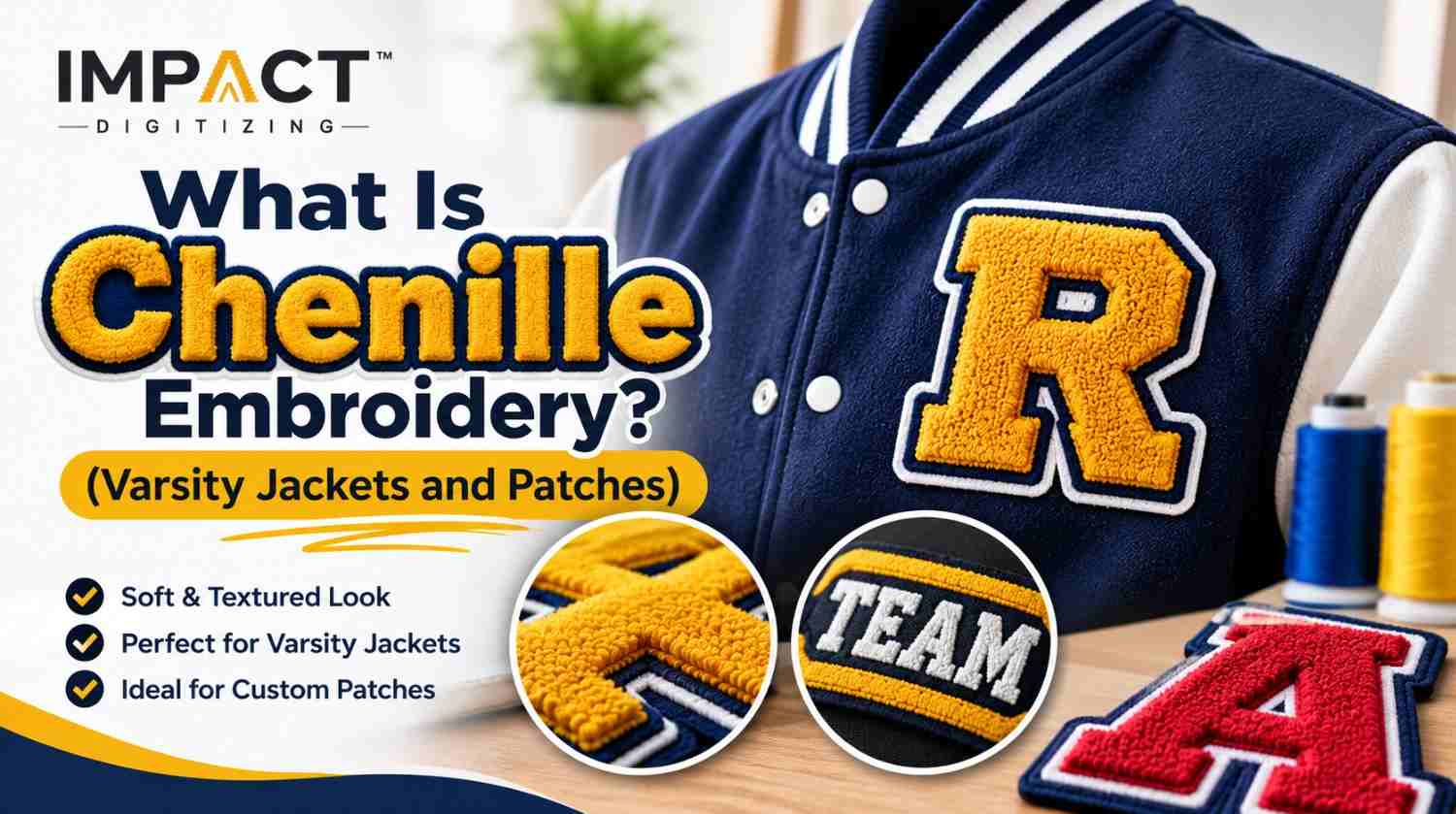
It’s the soft, cuddly letter on a letterman jacket that represents timeless charm. But beyond classic college apparel, such letters bring additional personality to modern streetwear garments. Are you wondering what chenille embroidery is? It’s a special technique involving looping yarn into designs. This guide will show you the process of production, comparison between chenille and felt options, cost details, and the ordering process.
How Chenille Embroidery Works
Chenille in French means “caterpillar,” which is a rather appropriate description of this kind of soft and fuzzy thread used in this embroidery method. In flat stitching, normal machines are utilized, while chenille embroidery is done with special chain-stitch machines where the thread is pushed from behind on the surface of the fabric, creating thousands of loops.
Unlike the lockstitch system with its bobbin, loop stitch machines have a single needle feeding the continuous yarn. A standard chenille embroidery construction includes:
- Base Fabric: Strong material such as felt or thick wool fabric.
- Looped Fill: Soft acrylic or cotton yarn that makes up the middle layer.
- Flat Border: The classic satin stitch border that holds everything together and makes the image more defined.
All this creates a unique 3D look which makes any graphic come to life.
Chenille vs Regular Embroidery
Traditional embroidery is done on flat satin stitch to produce fine lines and fonts. In chenille embroidery patches, there is an emphasis on graphics that make a bigger impact. Since there are heavy yarn loops that make thick lines, the fine details get lost in the pile. Good images have large shapes, bold letters, and simple silhouette borders.
| Feature | Chenille | Regular Embroidery |
| Look | Raised, fuzzy, 3D surface | Smooth, flat thread coverage |
| Texture | Soft, carpet-like yarn loops | Firm, dense stitching |
| Detail Level | Low (best for bold shapes) | High (crisp text & fine detail) |
| Best Used For | Varsity letters, mascots | Small chest logos, fine text |
Since narrow lines tend to blend in with the yarn loops, scale is a key factor to consider. Knowing the reasons why big patches are better than small patches is the first lesson towards creating loop pile from lines.
What Chenille Patches Are Made Of
Every patch is made up of layers that ensure that the design feels soft and also provides structure. Learning about these base elements will enable you to select appropriate specifications for your design:
- Yarn Layer: Thick acrylic yarn that is thick is preferred since it retains bright colors without losing them, but there is also some cotton or wool blend yarn.
- Base Layer: Thick felt is what is preferred in the industry due to its fibrous nature that keeps the yarn loops attached.
- Outline Layer: Polyester or rayon embroidery thread ensures that there is a clear outline of the yarn.
- Backing Options: Choose from sew-on backing, heat-seal iron-on backing, or hook-and-loop (Velcro).
Pro Tip: Although iron-on backings are perfect for temporary placements, it is advised that all heavy and large designs must have a sewn-on stitch on the perimeter.
How Chenille Letters Are Made
Production of clean chenille letters needs skilled artwork creation and accurate machine settings. It involves six consecutive stages:
- Artwork Simplification: Thin lines are made thicker, and small spaces are modified to make sure that the yarn does not obscure the shapes.
- Digitization: The design is translated into a computerized file for use with the chain stitch machine.
- Base Preparation: Heavy felt backing is cut and attached to the embroidery hoop.
- Yarn Looping: The embroidery machine creates yarn loops with the help of its automatic chenille patch embroidery head.
- Border Stitching: A border stitch in satin fabric is applied on the outer edges to secure the end of the yarns.
- Finishing & Trim: Once completed, the patch is cut out using a die-cutter, backing material is added, and all loose yarns are checked manually.
- Quality Check: Proper digitizing is critical here. If loop density is set too low, the base felt will show through; if it’s set too high, the needle can jam or bunch the material.
Chenille on Varsity Jackets
The traditional chenille varsity jacket stands as the standard of success in academic as well as athletic arenas. The varsity jacket was first introduced on Harvard campus letterman sweaters, and these badges soon became the gold standard worldwide.
Common placement ideas include:
- Left Chest: Oversized initial chenille letter patches or official school letters (typically 4 to 6 inches tall).
- Sleeves: Graduation year numbers, position titles, or state championship icons.
- Back: Oversized team mascots, school names, or full custom crests (10 to 12 inches).
Modern fashion brands and streetwear labels have taken this classic look out of the gymnasium and onto denim, bomber coats, and hoodies. For creative inspiration, check out our favorite patch project ideas to see how modern creators style chenille varsity patches and standard varsity jacket patches.
Chenille vs Felt vs Tackle Twill (Comparison Table)
When deciding on materials for large lettering or outerwear, it helps to understand how these popular options stack up:
| Feature | Chenille | Felt | Tackle Twill | Regular Embroidery |
| Surface | Looped, plush, raised | Flat, matte, soft | Flat, smooth, layered | Flat, stitched |
| Detail Level | Low (bold shapes) | Low to medium | Medium (sharp edges) | High |
| Best For | Varsity letters, mascots | Simple crafts, vintage designs | Athletic jerseys, team numbers | Small logos, detailed text |
| Durability | High | Medium | High | High |
| Relative Cost | Premium | Economical | Mid-range | Flexible |
Note: Felt is nearly always chosen as the material upon which a chenille emblem will be sewn, so you won’t always need to choose between the two! If you’d rather have a crispy layer of stitches than a fuzzy surface, see our guide about tackle twill.
Can Chenille Patches Be Washed?
Can chenille patches be washed safely? Yes, but yarn loops require proper care to prevent tangling, matting, or shrinking over time.
Care Do’s and Don’ts
Do:
- Hand wash or spot clean using cold water and mild detergent whenever possible.
- Turn garments inside out before washing to protect yarn loops from friction.
- Always lay the item flat on a towel to air dry naturally.
Don’ts:
- Don’t use heat dryers, as high temperatures ruin loop volume and shrink felt bases.
- Don’t scrub yarn loops vigorously with hard brushes.
- Don’t apply harsh bleach solutions or direct high-heat irons across the front face.
For varsity jackets featuring heavy leather sleeves, professional dry cleaning is recommended; just ensure the cleaner is experienced with wool and textured patch materials.
How Much Do Custom Chenille Patches Cost?
The price of custom chenille patches is based on a few simple manufacturing variables:
- Size & Pile Height: Larger patches will use much more yarn and require more manufacturing time.
- Color Count: A blend of yarn colors demands special machine configuration.
- Order Volume: Large orders greatly reduce the setup fee per item.
- Backing & Edging: Heat-seal backing and complicated laser cutting will slightly increase the price per patch.
As the setup time for chain stitch machinery is higher than ordinary embroidery, small orders have a higher price per piece. For optimal budget use, read our best tips for ordering patches online before finalizing your art.
Choosing a Chenille Patch Manufacturer
Working with a seasoned chenille patch manufacturer means that your patches will always have even, dense loops with durable stitching. When evaluating suppliers to produce your custom varsity patches, inspect their portfolio for loop consistency, digital sample accuracy, and art preparation capabilities.
At Impact Digitizing, we offer professional artwork prep and professional embroidery digitizing services. If you require digitized embroidery designs for loop stitch machines or even custom patches, our technical experts will help you out.
The Bottom Line
Chenille embroidery is known for its ability to create a classic and tangible design that adds value to varsity jackets, sportswear, and street fashion apparel. With striking artwork and machine digitization, you get tight loops and dynamic dimensionality. Focus on clean designs, proper care, and expert production setups to bring your custom patch concepts to life.
Elevate your outerwear with Impact Digitizing, delivering expertly prepared and digitized designs for premium, long-lasting custom chenille patches.
FAQs
1. What is chenille embroidery?
It is a textured method of using looped yarn to make raised and plush designs, commonly seen as lettering on varsity jackets and patches.
2. How is chenille different from regular embroidery?
The basic method of sewing is very flat and detailed. In chenille embroidery, looping piles are used to make bold and elevated shapes with fewer details.
3. What is a chenille patch made of?
Yarn loops on a felt or twill foundation, often with embroidered outlines and backed with either sewing, ironing, or Velcro tape.
4. How are chenille letters made?
They are designed using a digital file, which then dictates how the chain stitch machine loops the yarns on a cut felt fabric. They are outlined and trimmed.
5. Can chenille patches be washed?
Yes, carefully. Spot cleaning and hand-washing in cold water only. Dry flat, and do not use heat or rough cleaning tools.
6. How much do custom chenille patches cost?
The price will vary based on size, color, shape, backing, and quantity. Bigger orders reduce the price per item, so please inquire for pricing.
7. Can I make chenille on a regular home embroidery machine?
Not true chenille. Home machines stitch flat lock stitches, and real loop pile needs a specialized chain-stitch machine. You can only mimic the look with specialty faux techniques.
8. What’s the difference between chenille and felt patches?
A felt patch is a flat patch of fabric. A chenille patch is made using yarn loops, while felt is used as the base for backing.