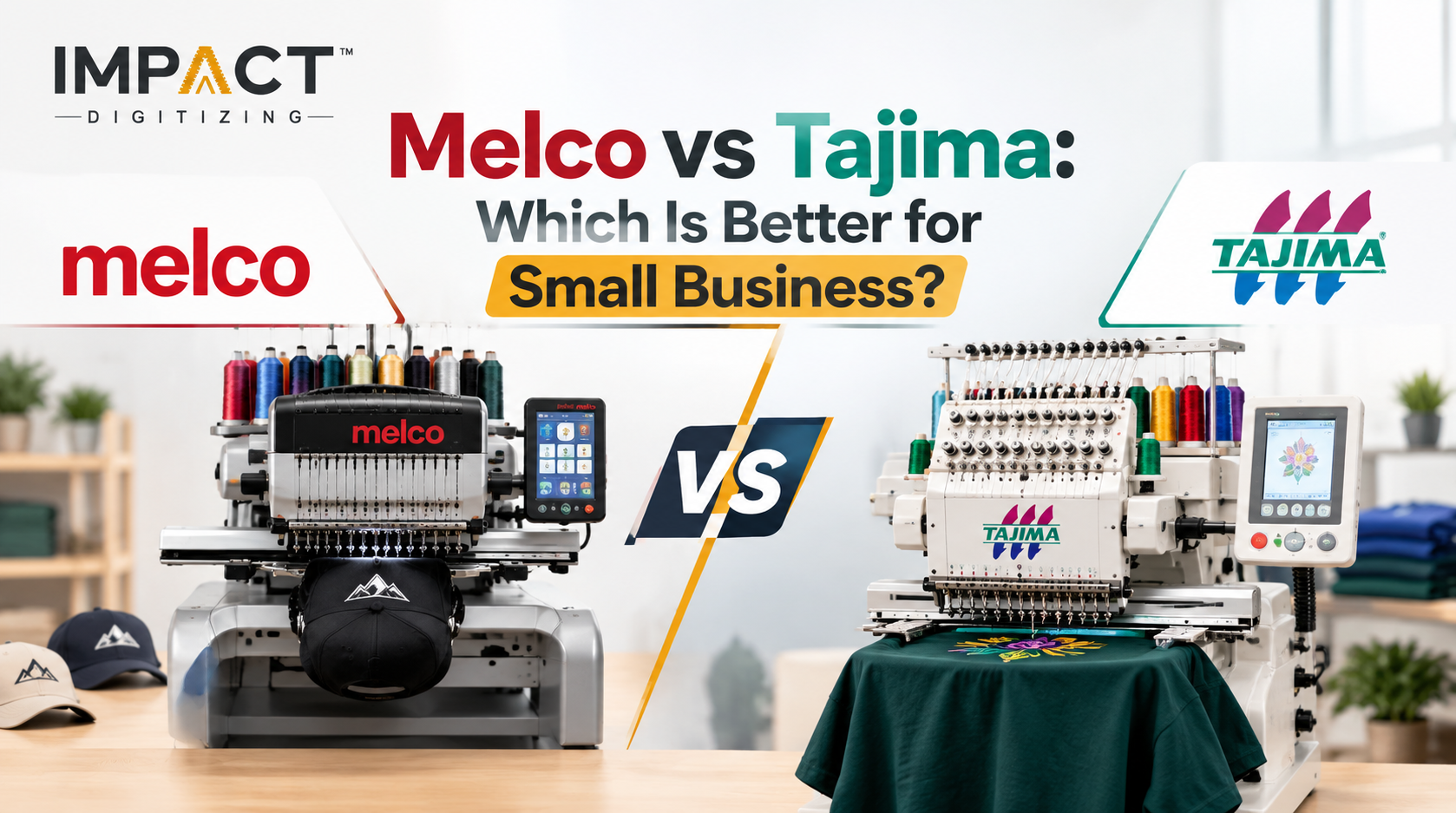
Melco vs Tajima is a fight each entrepreneur faces while trying to make the transition from a hobbyist level to a professional production studio. Finding the right balance between capital requirements, production time, and error rates is very important when picking an embroidery machine for a small business. A commercial analysis approach eliminates all marketing hype, protecting your finances, reducing costs caused by any machine downtime, and buying the right machine to start with.
Melco vs Tajima: Why This Comparison Matters for Small Business
Both manufacturers hold massive sway over the commercial embroidery space, but they cater to entirely different stages of growth. Many startups either blow their capital on heavy-duty equipment they aren’t busy enough to justify, or they buy cheap gear that breaks down the moment order volume picks up.
Your order size, garment selection, and schedule of growth must dictate this decision, rather than simply your brand’s preference. Before proceeding, review our detailed guide on How to Choose a Commercial Embroidery Machine to learn how machine specifications affect production capacity.
Quick Comparison: Melco vs Tajima at a Glance
Navigating any commercial embroidery machine comparison means looking at how specifications align with daily output. Finding the best embroidery machine for small business operations depends heavily on your workspace limitations and growth trajectory.
| Feature | Melco | Tajima |
| Typical Configuration | Single head | Single & multi-head |
| Best For | Startups, home-based businesses | Scaling businesses, production shops |
| Learning Curve | Beginner-friendly | Moderate |
| Upfront Investment | Lower | Higher |
| Long-Term Durability | Solid, single-head focused | Industry benchmark for uptime |
| Service Network | Growing | Long-established, widespread |
Melco Embroidery Machine: Strengths and Limitations
Investing in a Melco embroidery machine usually attracts business owners who want flexibility and don’t need a big starting setup. It works basically as a modular single-head embroidery machine that can fit well in empty rooms, homes, or any other small workshop space.
- Space-Saving Design: Perfect for those who work at home or have small business environments.
- Software Integration: This software is user-friendly, and therefore, new users can easily use it.
- Capital Efficiency: Spending less money on each unit helps reduce financial risk while checking if the market needs the product.
- Output Caps: The standalone single-head architecture limits massive bulk order fulfillment.
For solo creators navigating their first 12 to 24 months, this setup often hits the sweet spot. If you are exploring budget-friendly tiers, check out our reviews on Best Cheap Embroidery Machines. You can also look into alternative single-head options like our Ricoma EM-1010 Embroidery Machine Review for more startup inspiration.
Tajima Embroidery Machine: Strengths and Limitations
On the flip side, a Tajima embroidery machine stands as a gold standard for heavy-duty commercial garment decoration. Integrating a multi-head embroidery machine for business setups allows commercial print shops to tackle massive runs of corporate uniforms or school merchandise simultaneously.
- Industrial Uptime: Designed to work around the clock through several shifts without frequent thread breaks and timing problems.
- Resale Strength: Keeps its value exceptionally well thanks to the renowned brand endurance and availability of mechanics.
- Financial Barrier: Involves higher costs and needs constant income or client contracts to cover the expense of the design.
Shops ready to transition past custom one-offs into high-volume wholesale fulfillment find that Tajima systems provide the necessary endurance. For multi-head layout ideas, take a look at our 4-Head Embroidery Machine Guide.
Melco vs Tajima Price: What You Actually Pay
Analyzing the Melco vs Tajima price structure involves looking far beyond the initial invoice. While initial equipment outlays differ, total cost of ownership shifts once you factor in labor hours, maintenance, and production speed.
| Cost Factor | Melco (Single Head) | Tajima (Single/Multi Head) |
| Machine Price Range | Lower entry point | Higher, scales with heads |
| Maintenance Cost | Moderate | Moderate to low (long-term) |
| Software/Digitizing Cost | Comparable across both brands | Comparable across both brands |
| Break-Even Timeline (small business) | Faster on low order volume | Faster on high order volume |
As your daily output grows, the cost gap narrows because efficient throughput generates faster returns. Talk to Our Embroidery Digitizing Company Experts About Your Setup →
Tajima vs Melco Reliability: Which Holds Up Long-Term
Evaluating Tajima vs Melco reliability highlights differences in engineering philosophy. Tajima units are widely celebrated for industrial endurance under relentless daily stress, making them a favorite for multi-shift production houses. Meanwhile, Melco systems offer impressive reliability for moderate, boutique-style production scales. Regardless of the badge on the chassis, rigorous preventive maintenance, timely oiling, and clean workspace habits determine how many millions of stitches your equipment will execute without a service call.
Single Head vs Multi Head: Which Fits Your Business Stage
Deciding between equipment tiers comes down to your current order profile:
- A single-head embroidery machine excels when handling highly variable custom designs, personalized names, and small-batch promotional goods.
- A multi-head embroidery machine for business environments is essential when you secure recurring contracts for hundreds of identical corporate polos or sports team kits.
Many successful shops start on a single-head unit to master the craft before adding modular heads or upgrading to industrial multi-head lines. Explore more details in our comparison on Single Needle vs Multi Needle Machines.
Which Should You Choose? Decision Framework
To finalize your equipment strategy, weigh these core operational checkpoints:
- Go with Melco if: You are under 12 months into operations, handle unpredictable custom orders, or need to keep startup overhead tightly controlled.
- Go with Tajima if: You already possess consistent bulk orders, have capital to invest, and need absolute mechanical uptime to scale production rapidly.
No matter which brand you select, remember that poor embroidery files will cause thread breaks and birdnesting on any machine.
Conclusion
Choosing between Melco and Tajima hinges on your startup capital and volume trajectory. Impact Digitizing provides the foundational embroidery files you need to keep your shop running efficiently, whether you operate early-stage boutique equipment or heavy-duty multi-head industrial lines. Match your order volume to the right tier to protect cash flow.
FAQs
Which is better for a small business, Melco or Tajima?
Melco fits early-stage, low-volume startups best, while Tajima excels for scaling operations requiring heavy industrial endurance.
What is the price difference between Melco and Tajima machines?
Melco single-heads generally have a lower entry cost, whereas Tajima systems require a higher initial investment that scales with multi-head options.
Are Melco machines good for beginners?
Yes, Melco systems feature a user-friendly interface and simplified software integration suited for newcomers.
How reliable is Tajima compared to Melco?
Tajima is an industrial benchmark for heavy multi-shift uptime, while Melco provides solid reliability tailored for boutique production.
Which brand needs less maintenance, Melco or Tajima?
Tajima systems typically demand less daily intervention under heavy stress, whereas Melco units require precise routine tuning of active-feed components
Can I run a profitable embroidery business with a single-head machine?
Yes, single-head units drive high profitability for custom boutique orders, personalized items, and small-batch runs.