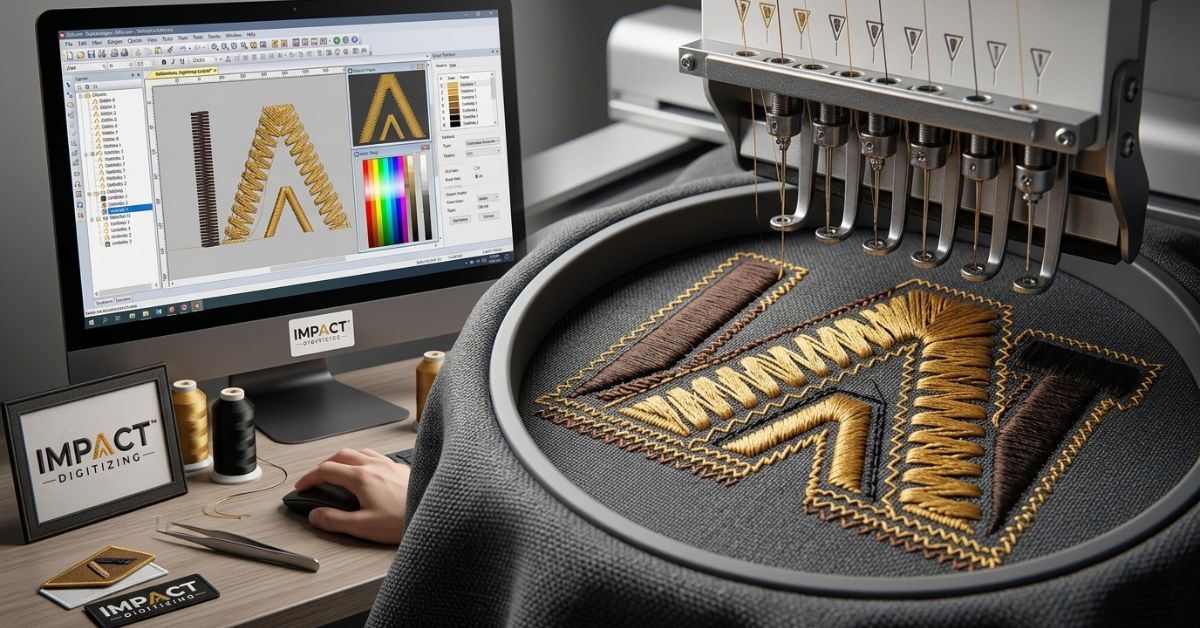
Ever wondered what the underlay is in embroidery digitizing and why some of the designs appear clean while others appear wrinkled? Poor underlay planning is responsible for poor results that cause distortion and confusion in designs. Imagine an underlay as the base of a building. Without it, the beautiful building on top may become loose and disintegrate over time. Choosing the correct embroidery underlay types guarantees the proper positioning of your design.
What Is Underlay in Embroidery Digitizing?
To put it simply, underlay is the “hidden skeleton” of embroidery. It is created during the digitizing process before the final stitching begins.
These embroidery underlay stitches:
- Hold the fabric and stabilizer together.
- Prevent fabric shifting during stitching.
- Support satin and fill stitch areas.
- Improve edge sharpness and design clarity.
In professional embroidery digitizing, the placement of the underlay is planned carefully. It usually starts a little bit inside the edge of the design (about 0.4mm) to help create a strong stitch.
Why Embroidery Underlay Stitches Matter for Every Design
Why are embroidery underlay stitches so critical? Without them, you face jagged edges, thread pull, and fabric “show-through”. A professional embroidery digitizing setup uses an underlay to:
- Create Crisp Borders: The underlay acts as a “break wall,” stopping the top thread from pulling too far into the fabric.
- Stabilize Loosely Woven Fabrics: On items like polo shirts, fleece, or caps, underlay prevents stitches from sinking into the “valleys” of the fabric weave.
- Reduce Density: Correct underlay provides enough “lift” that you can actually lower the top-stitch density, keeping the garment soft rather than “bulletproof”.
The 5 Main Embroidery Underlay Types Explained
Selecting the right embroidery underlay types depends on your design’s width and the fabric you’re using.
| SNO | Underlay Type | Used For | Column Width | Key Benefit |
| 1 | Center-Run | Narrow satin stitches | 1.5mm–2mm | Provides a simple guide for tiny columns. |
| 2 | Edge-Run | Wider satin columns | 2.5mm–3.5mm | Creates a clean “break wall” to stop thread pull. |
| 3 | Zigzag | Medium-wide columns | 4mm+ | Secures the empty center space in wide areas. |
| 4 | Double Zigzag | Stretch fabrics | 4mm+ | Provides maximum stability for activewear. |
| 5 | Fill-Stitch | Large fill areas | Large objects | Runs opposite to the top stitch to reduce pull. |
Order matters. A zigzag must be stitched before an edge-run; otherwise, the zigzag will pull the edge-run inward, ruining your crisp border. Using the correct embroidery underlay types at each stage ensures a high-quality finish.
Tatami Underlay in Embroidery: When and Why to Use It
Tatami underlay embroidery is used for large filled areas where standard underlay is not enough.
It is created using a fill-stitch pattern that runs in the opposite direction of the top stitches. This helps:
- Reduce fabric pull and distortion.
- Stabilize large logo fills.
- Improve smoothness in big embroidery sections.
It’s really good for the backs of jackets, logos on the chest, and the front of caps, where you require a lot of coverage. Tatami underlay embroidery provides the necessary density to prevent the fabric from puckering under heavy stitch counts.
Common Underlay Mistakes (And How to Fix Them)
Even expert sewers can experience difficulties where their basic stitches used for embroidery are done incorrectly. Many of these issues stem from improper embroidery underlay stitches.
1. The “Jagged Edge”
- Mistake: If you align text centrally within a broad column, the edges can appear jagged.
- Fix: Border define karne ke liye edge-run ka use karein.
2. The “Popped Thread”
- Mistake: Placing the underlay too close to the edge causes it to peek out from under the satin stitch.
- Fix: In stitches ko hamesha 0.4mm inset (andar) rakhein.
3. The “Sinking”
- Mistake: Using standard 2.5mm stitch lengths on fleece.
- The Fix: Lengthen stitches or use a knockdown stitch to flatten fibers.
If your file is failing, you can use Impact Digitizing’s revision service to re-digitize the foundation for a perfect stitch-out.
How Impact Digitizing Handles Underlay for Perfect Results
When you choose an embroidery digitizing service, you aren’t just paying for a file; you’re paying for the engineering beneath the stitches.
- Fabric-Specific Selection: We don’t use “auto-underlay.” Every file is manually reviewed to match your specific fabric, whether it’s pique, denim, or performance wear.
- Manual Review: We check every column width to assign the mathematically correct underlay type. Our experts ensure tatami underlay embroidery is applied where necessary for durability.
- Fast Turnaround: Get your optimized files back in record time, ready to run on any machine without the headache of thread breaks.
Conclusion
Underlay is a crucial foundation for creating an excellent embroidery design. Invisible stitches not only provide stability to a garment but also prevent its deformation and create neat outlines. Such seemingly minor things have the ability to transform an ordinary design into something truly professional. Learning various kinds of underlays ensures that your designs will be clear, precise, and beautiful.
Impact Digitizing provides expert manual underlay engineering tailored to your specific fabric for a flawless finish.
FAQs
1. What happens if you skip the underlay in embroidery?
The design will likely pucker, shift, or sink into the fabric, losing its shape and crispness.
2. What is the most common underlay type used in digitizing?
Edge-run and center-run are the most frequent, often used together to stabilize satin stitch columns.
3. Does underlay affect stitch count?
Yes, it adds stitches, but it allows you to lower top-stitch density, often balancing the total count.
4. How much underlay density should I use?
Keep it low; underlay should provide a supportive framework, not a thick, solid block of thread.
5. Is an underlay the same as a stabilizer?
No, stabilizer goes under the fabric; underlay consists of stitches placed on top of the fabric/stabilizer.
6. Which underlay works best for caps and hats?
Center-run, combined with edge-run, provides the best stability for the curved, shifting surface of a cap.
7. Can you have too much underlay?
Yes. Excessive underlay makes the design stiff, “bulletproof,” and increases the risk of needle breaks.
8. Does the underlay differ for satin vs fill stitches?
Yes, satin stitches use a run/zigzag underlay, while fill stitches typically use a perpendicular tatami or mesh underlay.